
What to do with rainwater when surfaces are sealed? This question is becoming increasingly important in construction projects.
Recycling expert Reiling recently had to deal with this problem for a warehouse extension at the glass recycling site in Osterweddingen. The solution is a modern retention basin with Veriso RED expanded glass gravel as a water reservoir. The material, which consists of recycled waste glass, stores water, absorbs dynamic loads cyclically and thus enables further utilisation of the area so that valuable space is not wasted. The retention basins relieve the pressure on the sewer system, support the natural water cycle and make an important contribution to sustainable construction.
Where to put the precipitation? This is one of the pressing questions that planners ask themselves in new construction projects. This is because large areas of wasteland are sealed for the construction of warehouses, car parks, residential areas or production buildings. Where previously rainwater could seep into the ground, expansive concrete and asphalt surfaces interrupt the natural water cycle. The consequences are far-reaching and can already be felt. Flooding, flood disasters, the increase in heavy rainfall events and the formation of heat islands in cities are just a few examples of this home-made problem. While there have been no efforts to counteract land sealing for many decades, the requirements are still dependent on local regulations today. Fortunately, there is a growing understanding of the risks associated with land sealing and more and more cities and municipalities are making compensation areas, for example in the form of rainwater retention basins, a condition for planning permission.
Retention basin for recycling expert
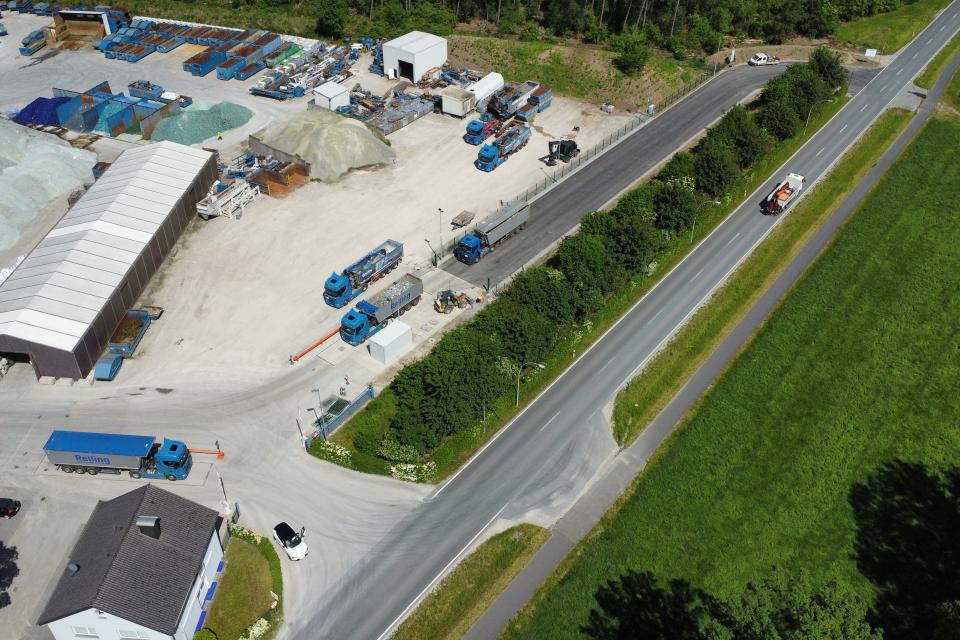
This is also the case in Osterweddingen, where the recycling expert Reiling has planned to expand its factory premises by one hectare.
To compensate for this, two rainwater retention basins had to be created. These are intended to serve as a buffer zone when it rains in order to relieve the connected sewer. "Normally, these retention basins would have been constructed like a pool in which the water is retained. For us, this would have meant losing the area above it," explains Thomas Schürmann, Head of Construction at Reiling. Although appropriately designed systems can usually be driven over, they would not be able to withstand the strain of the company's wheel loaders for long. "The paving stones on our factory premises sink by an average of four to eight centimetres per year. We can lay new paving stones without much effort, but a poured concrete surface over a water basin requires significantly more repair work," says Schürmann.
A convincing system component
True to the saying ‘Why go far away when good things are so close’, the solution to the problem was found in the next of kin. With RED expanded glass gravel, the subsidiary Veriso has developed a bulk material that can not only absorb cyclic dynamic loads, but also up to 50 per cent water by mass. The material, made from 100 per cent recycled waste glass, has already proven itself in the past as an innovative and ideal component for water storage systems. One of the reasons for this is that the expanded glass gravel releases the water slowly. This reduces absorption to twelve per cent after eight hours and to just three per cent after four days. These properties turned out to be a game changer for Reiling's retention basins. Wasting this area would have been completely unacceptable for Reiling, so a fully functional alternative was essential.
The construction
To build the retention system, the turf was first excavated to a depth of around 25 centimetres and the soil was then stabilised by milling in lime. In order to ensure a controlled discharge into the sewer and not to exceed the discharge coefficient of 50 litres per second, a barrier sheet was laid. On top of this, each basin was initially built up with a layer of Veriso RED expanded glass gravel filling 800 cubic metres and 450 millimetres high. Above this is a 300 millimetre thick gravel base layer. The different layers are stabilised by a geosynthetic fabric with a separating fleece insert. Finally, the construction of the paving begins with a 50 millimetre thick chippings paving bed on which 100 millimetres of H-paving was laid. The absence of an asphalt layer allows water to penetrate unhindered into the buffer zone. The collected precipitation is released into the sewer in a controlled manner via drainage pipes. In addition, the expanded glass gravel is able to absorb the dynamic loads of heavy goods vehicles without damage. The paving layer can be replaced cost-effectively at any time if necessary. This means that the area required for the retention basins remains passable and therefore usable for Reiling.
‘Expectations were exceeded’
The business relationship between the two companies was an additional plus point in the decision in favour of the system structure with Red expanded glass ballast, but not the decisive factor. ‘The most important thing for us was that we lose as little area as possible to the retention system,’ emphasises Schürmann. At the same time, the company is looking forward to gaining its own experience with the award-winning building material from Veriso and experiencing the positive product properties for itself in a practical test. ‘The expectations we had of the collaboration have already been exceeded,’ concludes Schürmann. He attributes this to the extensive services provided, such as support with planning and the simple handling of all processes. Reiling's contribution to the sustainability of the construction project is not to be underestimated. As the expanded glass ballast consists of recycled used glass, this minimises the extraction of new resources. In addition, the bulk material is not only pressure-resistant but also weather-resistant. The fibre- and solvent-free expanded glass gravel is absolutely non-toxic for the environment and, thanks to its easy recyclability, is perfectly suited to the construction industry's goal of a circular economy.